1
2
3
4
5
6
7
8
9
10
11
12
13
14
15
16
17
18
19
20
21
22
23
24
25
26
27
28
29
30
31
32
33
34
35
36
37
38
39
40
41
42
43
44
45
46
47
48
49
50
51
52
53
54
55
56
57
58
59
60
61
62
63
64
65
66
67
68
69
70
71
72
73
74
75
76
77
78
79
80
81
82
83
84
85
86
87
88
89
90
91
92
93
94
95
96
97
98
99
100
101
102
103
104
105
106
107
108
109
110
111
112
113
114
115
116
117
118
119
120
121
122
123
124
125
126
127
128
129
130
131
132
133
134
135
136
137
138
139
140
141
142
143
144
145
146
147
148
149
150
151
152
153
154
155
156
157
158
159
160
161
162
163
164
165
166
167
168
169
170
171
172
173
174
175
176
177
178
179
180
181
182
183
184
185
186
187
188
189
190
191
192
193
194
195
196
197
198
199
200
201
202
203
204
205
206
207
208
209
210
211
212
213
214
215
216
217
218
219
220
221
222
223
224
225
226
227
228
229
230
231
232
233
234
235
236
237
238
239
240
241
242
243
244
245
246
247
248
249
250
251
252
253
254
255
256
257
258
259
260
261
262
263
264
265
266
267
268
269
270
271
272
273
274
275
276
277
278
279
280
281
282
283
284
285
286
287
288
289
290
291
292
293
294
295
296
297
298
299
300
301
302
303
304
305
306
307
308
309
310
311
312
313
314
315
316
317
318
319
320
321
322
323
324
325
326
327
328
329
330
331
332
333
334
335
336
337
338
339
340
341
342
343
344
345
346
347
348
349
350
351
352
353
354
355
356
357
358
359
360
361
362
363
364
365
366
367
368
369
370
371
372
373
374
375
376
377
378
379
380
381
382
383
384
385
386
387
388
389
390
391
392
393
394
395
396
397
398
399
400
401
402
403
404
405
406
407
408
409
410
411
412
413
414
415
416
417
418
419
420
421
422
423
424
425
426
427
428
429
430
431
432
433
434
435
436
437
438
439
440
441
442
443
444
445
446
447
448
449
450
451
452
453
454
455
456
457
458
459
460
461
462
463
464
465
466
467
468
469
470
471
472
473
474
475
476
477
478
479
480
481
482
483
484
485
486
487
488
489
490
491
492
493
494
495
496
497
498
499
500
501
502
503
504
505
506
507
508
509
510
511
512
513
514
515
516
517
518
519
520
521
522
523
|
# dfm (Dylan's File Manager)
A powerful, simple and snappy terminal file manager with minimal resource usage.
<a href="https://asciinema.org/a/mjFhlSN0VsV1Xt59" target="_blank"><img src="https://asciinema.org/a/mjFhlSN0VsV1Xt59.svg" alt="img" height="213px" align="right"/></a>
Initial Announcement: https://dylan.gr/1772192922
* Tiny (`CONFIG_SMALL`: ~90KiB, `CONFIG_TINY`: ~40KiB, `CONFIG_TINY`+ `-static`: ~150KiB)
* Fast (should only be limited by IO)
* No dynamic memory allocation (~1.5MiB static)
* Does nothing unless a key is pressed
* No dependencies outside of POSIX/libc
* Manually implemented TUI <img src="https://dylan.gr/img/dfm1.png" alt="screenshot" height="213px" align="right"/>
* Manually implemented interactive line editor
* Efficient low-bandwidth partial rendering
* UTF8 support (minus grapheme clusters and other unruly things)
* Inline image viewing (sixel, kitty)
* Multiple view modes (name, size, permissions, mtime, ...)
* Multiple sort modes (name, extension, size, mtime, reverse, ...)
* Ranger-style bulk rename <img src="https://dylan.gr/img/dfm2.png" alt="screenshot" height="213px" align="right"/>
* Incremental as-you-type search
* Bookmarks
* Vim-like keybindings
* Customizable keybindings
* Command system
* Multi-entry marking
* Basic operations (open, copy, move, remove, link, etc)
* Watches filesystem for changes
* CD on exit
* And more...
## Table of Contents
<!-- vim-markdown-toc GFM -->
* [Dependencies](#dependencies)
* [Building](#building)
* [Configuration](#configuration)
* [DPP (Dylan's Preprocessor)](#dpp-dylans-preprocessor)
* [Command-line](#command-line)
* [Environment](#environment)
* [CD On Exit](#cd-on-exit)
* [Usage](#usage)
* [Statusline](#statusline)
* [View Modes](#view-modes)
* [Sort Modes](#sort-modes)
* [Prompt](#prompt)
* [Images](#images)
* [Searching](#searching)
* [Marking](#marking)
* [Commands](#commands)
* [Privilege Escalation](#privilege-escalation)
* [Bound Commands](#bound-commands)
* [Design Considerations](#design-considerations)
* [Conclusion](#conclusion)
<!-- vim-markdown-toc -->
## Dependencies
Required:
- POSIX `cat`, `cp`, `date`, `mkdir`, `printf`, `rm`, `sh`
- POSIX `make`
- POSIX libc
- C99 compiler
Optional:
- `strip` (for `CONFIG_SMALL` and `CONFIG_TINY`)
- `clang` (for `CONFIG_TINY`)
- `chafa` (for image view using `sixel`)
- `kitty` (for image view `kitty`)
## Building
```sh
$ ./configure --prefix=/usr
$ make
$ make DESTDIR="" install
```
The configure script takes three forms of arguments.
1) Long-opts: `--prefix=/usr`, `--help`
2) Variables: `CC=/bin/cc`, `CFLAGS="-O3"`, `LDFLAGS=" "`
3) C macro definitions: `-DMACRO`, `-DMACRO=VALUE`, `-UMACRO`
There are three different build configurations.
1) Default: `-O2`
2) `CONFIG_SMALL`: `-Os` + aggressive compiler flags
3) `CONFIG_TINY`: `-Oz` + `CONFIG_SMALL` + (you must set `CC=clang`)
- To produce a static binary, pass `-static` via `CFLAGS`.
- To enable LTO, pass `-flto` via `CFLAGS`.
Everything contained within `./configure`, `Makefile.in`, `config.h.in`,
`config_cmd.h.in` and `config_key.h.in` can be configured on the command-line
via `./configure`. See `./configure --help` and also refer to these files for
more information.
Bonus example:
```sh
./configure \
--prefix=/usr \
-DCONFIG_TINY=1 \
CC=clang \
CFLAGS="$CFLAGS -flto -static" \
-DDFM_NO_COLOR \
-DDFM_COL_NAV="VT_SGR(34,7)"
```
NOTE: If you are building for an environment without support for the XTerm
alternate screen, add `-DDFM_CLEAR_EDIT` to your configure flags.
## Configuration
`dfm` is configured at compile-time via its config files.
* `./configure`: Build system, compilation and installation.
* `config.h.in`: Default settings, colors, etc.
* `config_key.h.in`: Keybindings.
* `config_cmd.h.in`: Commands.
Refer to these files for more information.
### DPP (Dylan's Preprocessor)
The `config*.in` files are processed by `dpp` (see `bin/dpp`) so POSIX shell
code can be used within them. Everything defined by `./configure` is also
accessible within these files as variables.
See https://github.com/dylanaraps/dpp for more information.
### Command-line
```
usage: dfm [options] [path]
options:
-H | +H toggle hidden files (-H off, +H on)
-p picker mode (print selected path to stdout and exit)
-o <opener> program to use when opening files (default: xdg-open)
-s <mode> change default sort
n name
N name reverse
e extension
s size
S size reverse
d date
D date reverse
-v <mode> change default view
n name only
s size
p permissions
t time
a all
--help show this help
--version show version
path:
directory to open (default: ".")
```
### Environment
A few things can be set at runtime via environment variables. If unset in the
environment, default values are derived from the `config.h.in` file.
```
- DFM_COPYER (The clipboard tool to use when copying PWD or file
contents. The tool is fed the data via <stdin>)
- DFM_BOOKMARK_[0-9] (Directory bookmarks. set DFM_BOOKMARK_[0-9] and then
bind act_cd_bookmark_[0-9] to the keys of your choosing)
- DFM_OPENER (Opener script to use when opening files. This could be
xdg-open or a custom script (see the script/ directory))
- DFM_TRASH (Program to use when trashing files)
- DFM_TRASH_DIR (Path to trash directory)
- DFM_IMG_MODE (Image mode to use: 'chafa' (default), 'kitty')
- DFM_SU (Privilege escalation tool to use: 'sudo' (default))
```
### CD On Exit
There are two ways to exit `dfm`.
```
1) act_quit (default 'q')
2) act_quit_print_pwd (default 'Q')
```
Exiting with 2) will make `dfm` output the absolute path to the directory it was
in. This output can be passed to `cd` to change directory automatically on exit.
```
$ cd "$(dfm)"
$ var=$(dfm)
$ dfm > file
```
## Usage
`dfm` is a single column file-manager with VIM like keybindings. Its basic usage
is pretty straightforward and anything non-obvious can be divined by looking
at the actions each key is bound to.
### Statusline
The statusline is as follows:
```
1 1/1 [RnHE] [1+] ~0B /path/to/current/directory/<query>
1 - Shows nest level of dfm. Only shown if > 0.
1/1 - The entry number under the cursor and the total visible entries.
[RnHE] - Indicators.
R - Shown when dfm is running as root.
n - Current sort mode: [n]ame, [N]ame reverse, [s]ize,
[S]ize reverse, [d]ate modified, [D]ate modified reverse,
[e]xtension. If the current directory is too large, in place
of sort mode, [T] is shown.
H - Shown when hidden files are enabled.
E - Shown when a command fails. This indicates that the user must
check the alternate buffer (bound to 'z' by default) to see
the error messages left by the command failure.
[1+] - Number of marked files, hidden when 0.
~0B - Approximate size of directory (shallow, excludes sub-directories).
/path/to - The current directory.
/<query> - The search query if the list was filtered.
```
### View Modes
There are five view modes: Normal, Size, Permissions, Date Modified and All.
The view mode can be cycled by pressing `<Tab>` by default.
All is the sum of the other view modes and gives an idea of what is shown:
```
-rwxr-xr-x 16m 4.0K .git/
-rwxr-xr-x 2h 4.0K bin/
-rwxr-xr-x 4d 4.0K script/
-rwxr-xr-x 32m 4.0K lib/
-rwxr-xr-x 16h 4.0K platform/
-rw-r--r-- 16m 0B .config_macro.h
-rw-r--r-- 16m 62B .gitignore
-rw-r--r-- 4d 1.0K LICENSE.md
-rw-r--r-- 16m 1.8K Makefile
-rw-r--r-- 8h 1.8K Makefile.in
-rw-r--r-- 32s 6.6K README.txt
-rw-r--r-- 16m 4.0K config.h
-rw-r--r-- 32m 4.0K config.h.in
-rw-r--r-- 32m 6.5K config_cmd.h
-rw-r--r-- 32m 6.5K config_cmd.h.in
-rw-r--r-- 16m 6.5K config_key.h
-rw-r--r-- 32m 6.5K config_key.h.in
-rwxr-xr-x 16m 3.5K configure*
-rwxr-xr-x 16m 130K dfm*
-rw-r--r-- 32m 72K dfm.c
2/20 [nH] ~268K /home/dylan/kiss/fork/dfm
```
### Sort Modes
There are seven sort modes: `name`, `name reverse`, `size`, `size reverse`,
`date modified`, `date modified reverse`, `extension`. The sort mode can be
cycled by pressing '`' (backtick) by default.
The `name` sort performs a natural/human sort and puts directories before files.
### Prompt
The area where searches and commands are inputted is a complete interactive line
editor supporting all the usual actions (left/right scroll, insert,
bracketed clipboard paste, backspace, delete, prev/next word, etc).
The default keybindings match what is found in readline and POSIXy shells.
As of now there is no `<Tab>` complete or up/down arrow history cycling.
NOTE: The prompt is implemented as a gap buffer. There are two buffers, cursor
left and cursor right with the cursor sitting inbetween both buffers. When it
comes time to commit the input it is simply joined together. Make not of this
detail as it is necessary to know it when creating your own bound commands.
### Images
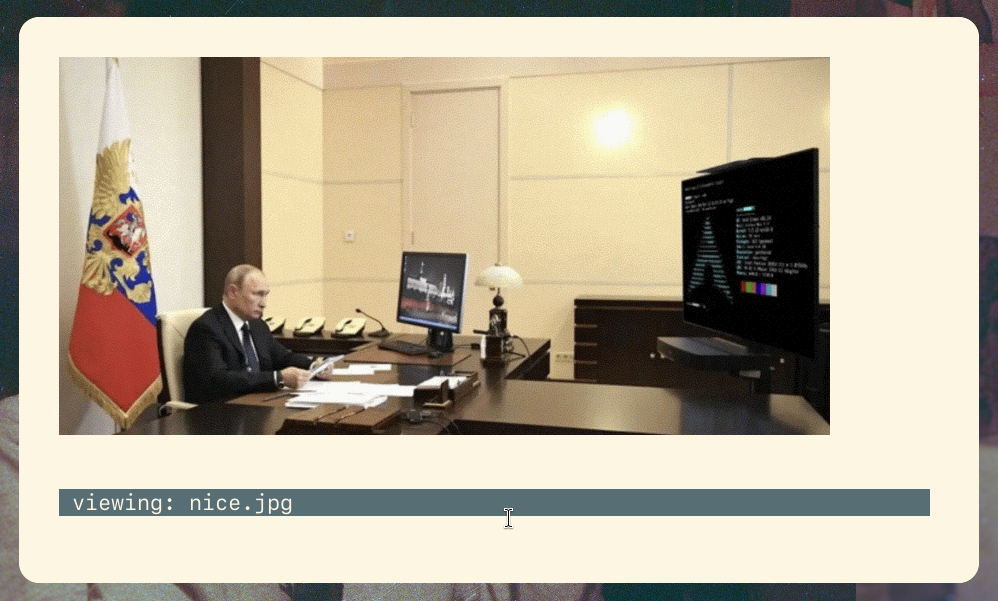
Images can be viewed inside of `dfm` by pressing `i` by default. This will
display the image and wait for a keypress before returning to the directory
listing. Two backends are supported: `sixel` (via `chafa`) and `kitty`.
The mode can be set in `config.h.in` or at runtime via an environment variable.
### Searching
There are two search modes: `startswith` (default `/`) and `substring`
(default `?`). They each perform a case-sensitive and incremental as-you-type
search on the current directory's entries.
Pressing `<Enter>` confirms the search and the results become navigable. If
there is only one match, pressing `<Enter>` will open the entry in a single
press.
### Marking
Files can be marked and unmarked (`<spacebar>` by default). There are also
shortcuts to navigate between marks, select all, clear all and to invert the
selection.
The marks can be operated on in three ways.
1) Foreach: A command is executed once per mark.
2) Bulk: A command is executed once and given the list of marks as its argv.
3) Shell: A shell command is executed (`sh -euc "<cmd>" <marks argv>`)
- NOTE: All three can also be executed in the background.
- NOTE: If nothing is marked, the entry under the cursor is operated on.
These operations are defined as "commands" which can be typed or bound to keys.
To avoid copying data, only the basenames of marks are passed to commands and
the commands are exec'd in the directory containing them.
Example:
```sh
cp -f %m %d -> PWD=/path/to/mark_dir cp -f a b c /path/to/pwd
```
### Commands
Commands are simply strings which are minimally transformed into argvs and
executed. Modifiers control how the string will be transformed and executed.
```
:echo hello -> echo hello
:echo %f world -> foreach entry: echo <entry> world
:echo %m world -> echo <entry_1> <entry_2> ... world'.
:<waycopy -> foreach entry: (stdin) waycopy
```
In addition to these modifiers are the following:
```
%p -> Path to PWD.
$WORD -> Expand environment variable.
& -> Run in background (must be last word)..
```
NOTE: None of the above transformations pass through or incur the cost of
running within a shell. They are merely pointer arrays passed to `exec()`.
NOTE: `%m` and `%f` cannot be combined and only the first occurrence of `%m` or
`%f` is evaluated. Also, `%m` and `%f` must appear on their own.
If these are too limiting, prepending a `!` bypasses `dfm`'s internal command mode
and sends it all to the shell.
```sh
:!echo "$@" -> sh -euc 'echo "$@"' <entry_1> <entry_2> ...
:!echo "$1" "$2" -> sh -euc 'echo "$1" "$2"' <entry_1> <entry_2> ...
```
### Privilege Escalation
Commands can be run as root by prepending `sudo` or a similar tool on the
command-line. For more complex situations, pressing `Z` by default will use
`DFM_SU` (default `sudo`) to spawn another `dfm` as `root`. The statusline will
be a different color, show the nest level and display an `R` indicator to make
the escalation obvious. Pressing `Z` again inside of this escalated mode quits
and returns to the original `dfm`.
This can be configured at runtime using the environment variable `DFM_SU` and
at compile time via the `config.h.in` file.
### Bound Commands
Commands can be bound to keys. When a command is bound it can either run
straight away or open the interactive prompt with pre-filled information.
Flags can also be set to better integrate the command into `dfm`.
Move is defined as follows:
```c
FM_CMD(cmd_move,
.prompt = CUT(":"), - The prompt.
.left = CUT("echo mv -f %m %d"), - Text left of cursor.
.enter = fm_cmd_run, - Callback.
.config = CMD_NOT_MARK_DIR | - Forbid running in mark directory.
CMD_MUT | - Command may mutate directory.
CMD_EXEC_MARK | - Skip interactive mode if marks.
CMD_CONFLICT, - Prompt on conflicts.
)
```
Chown is defined as follows:
```c
FM_CMD(cmd_chown,
.prompt = CUT(":"),
.left = CUT("chown"),
.right = CUT(" %m"), - Text right of cursor.
.enter = fm_cmd_run,
.config = CMD_MUT,
)
```
This opens the interactive prompt and puts the cursor between `chown` and `%m`
so the user can add additional information.
```sh
:chown | %a
```
In addition to `fm_cmd_run`, `fm_cmd_run_sh` can be set to bypass `dfm`'s
internal command mode to run the command in the shell.
See the `config_key.h.in` and `config_cmd.h.in` files for more information.
## Design Considerations
* I employed many tricks in order to keep memory usage low whilst still allowing
for fast operations and relatively large directory trees.
* When a directory too large for `dfm` is entered the statusline sort indicator
is replaced with `[T]` to signify truncation, sorting is disabled and the
statusline colored red. Truncation occurs when memory in the name storage or
entry list is exhausted, whichever comes first. The limits are reasonable and
unlikely to be reached outside of synthetic directory trees so this isn't
really a problem.
* File operations using coreutils commands work well but aren't as nice as
having fully integrated internal operations. I was working on it but it ended
up being a massive pain in the ass so I abandoned the idea. It's not enough to
use the POSIX functions as you will be left fighting `TOCTOU` race conditions,
control flow hell, error handling madness and other crap. A solution is to
conditionally use each OS's extension functions (ie, Linux's `copy_file()`,
`renameat2()`, `O_TMPFILE`, `AT_EMPTY_PATH`, etc) but then you end up stuck in
preprocessor `#ifdef` soup.
* UTF8 support intentionally excludes grapheme clusters, emojis and other
complicated things. Everything else should work just fine though.
* `dfm` will do partial rendering wherever possible and also tries to do as
little display IO as it can (this is what I mean by low-bandwidth in the
feature list).
* The TUI is manually implemented using VT100 escape sequences and a few
optional modern ones (bracketed paste, XTerm alt screen, synchronized
updates). Look at `lib/term.h`, `lib/term_key.h`, `lib/vt.h` and scan `dfm.c`
for `VT_.*` to see how it works.
NOTE: `dfm` works in pretty much every terminal emulator in wide use but since
it intentionally doesn't use terminfo it may not display correctly in some
environments (notably the TTY console in some BSDs). I don't think there's
anything I can do to remedy this unfortunately.
* The number of marks is bounded only when it comes to materializing them. For
1000 marks `dfm` needs the space to construct an `argv` to accommodate them.
This is not all, if a `cd` is performed, space is also needed to store the mark
entry names as the new directory will overwrite them. Marks are stored on the
end of the directory storage growing towards its middle. In other words,
materialized marks are stored in the free space not taken up by directory
entries. This creates two scenarios.
1) Inside the same directory as the marks `dfm` can mark and operate on all of
the entries without needing any extra memory as the marks are virtual.
However, if `%m` is used inside the mark directory, `dfm` must materialize
them and the number is bounded by whatever unused memory is available. This
doesn't limit operation on files as `dfm` will process the marks in chunks.
- `%f`: 900 marks -> n/a -> cmd <arg> x 900
- `%m`: 900 marks -> 300 slots -> cmd <args> x 3
2) Outside of the directory `dfm` needs space to materialize the marks so
mark that travel are bounded.
In short:
- in mark dir + `%f` == boundless mark operations.
- in mark dir + `%m` == boundless mark operations (chunked).
- outside mark dir + `%f` == bounded mark operations.
- outside mark dir + `%m` == bounded mark operations.
## Conclusion
I had a lot of fun writing this.
Thank you for reading.
- Also check out `dpp`: https://github.com/dylanaraps/dpp
- And my blog: https://dylan.gr
|